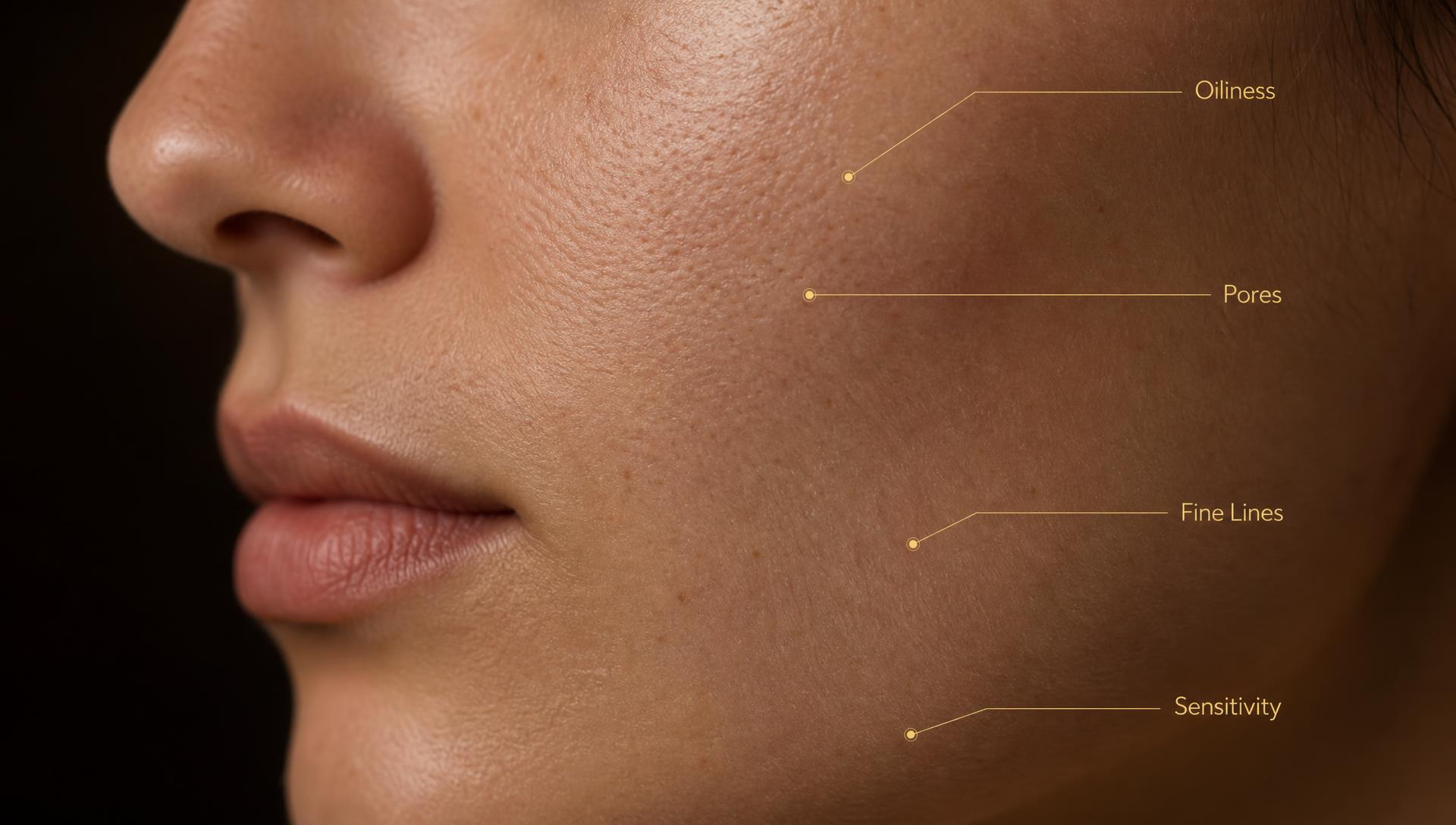
Your scan gives you two layers of results. The five markers up top (texture, tone, hydration, pigmentation, condition) are your Skin Balance Score at a glance. Below that sits your Full Skin Report: a deeper read of the same scan, broken into the specific things your skin is actually doing.
Here's what each section means, and how to read the numbers.
How to read the scores
How to read your results:
- Every score in your Full Skin Report runs 0 to 100.
- Higher always means more balanced, the same direction as your five headline markers.
- A few sections show plain bands instead of numbers (None seen, Mild, Moderate, Pronounced) for things that are more about presence than degree.
These are estimates from your photo, not a medical assessment. Lighting, angle and image quality all affect what a scan can pick up, so treat this as a snapshot to track over time, not a fixed label.
Oiliness & Sebum
What it reads: how much surface oil your scan detected, overall and by zone (T-zone, cheeks, chin). This is the marker that answers the question a lot of quizzes get wrong. Oily, dry, or somewhere in between isn't always obvious from how skin feels. This reads it directly.
Pores
How visible your pores appear, overall and broken down by zone. Pore visibility shifts with oil production and hydration, so this often moves alongside your Oiliness & Sebum result.
Blackheads & Congestion
Blocked-looking pores and closed bumps near the surface. This is about visible congestion, not a count of individual spots.
Blemish Activity
Active-looking spots and the marks they leave behind. A lower score here means more visible activity right now.
Fine Lines
Where surface lines read most strongly across your face: forehead, crow's feet, nasolabial folds, and under-eye. This is about current surface texture, not a prediction.
Eye Area
Under-eye shadowing and puffiness, read separately for left and right, since these often aren't symmetrical.
Pigmentation Detail
A more granular read of tone evenness across your face than the single Pigmentation marker up top.
Sensitivity
Signs of redness and reactivity detected in the surface.
Zone Overlays
Four visual maps show where each pattern reads strongest across your face: Redness, Pigment, Moisture, and Pore Texture, all using the same visual style as your Face Regions map.
Why this matters
The point of all of this isn't to hand you a list of problems. It's to replace guessing with something specific enough to actually act on. Your protocol is built from these exact readings, not a category you picked off a quiz.