"AI skin analysis" gets thrown around a lot right now. Some of it is genuinely useful. A lot of it is a filter with a fancy name attached.
So here's the honest version: what does an AI skin scan actually measure, and why does any of it matter for the routine you end up with?
It starts with a camera, not a quiz
A scan reads your face directly through your phone camera. No self-reported guesses about oily versus dry, no "how does your skin feel" multiple choice. Just what's actually there, at that exact moment.
That distinction matters more than it sounds like it should. Skin changes week to week. A quiz filled out once can't keep up with that. A scan can, because you can run it again whenever your skin has actually changed.
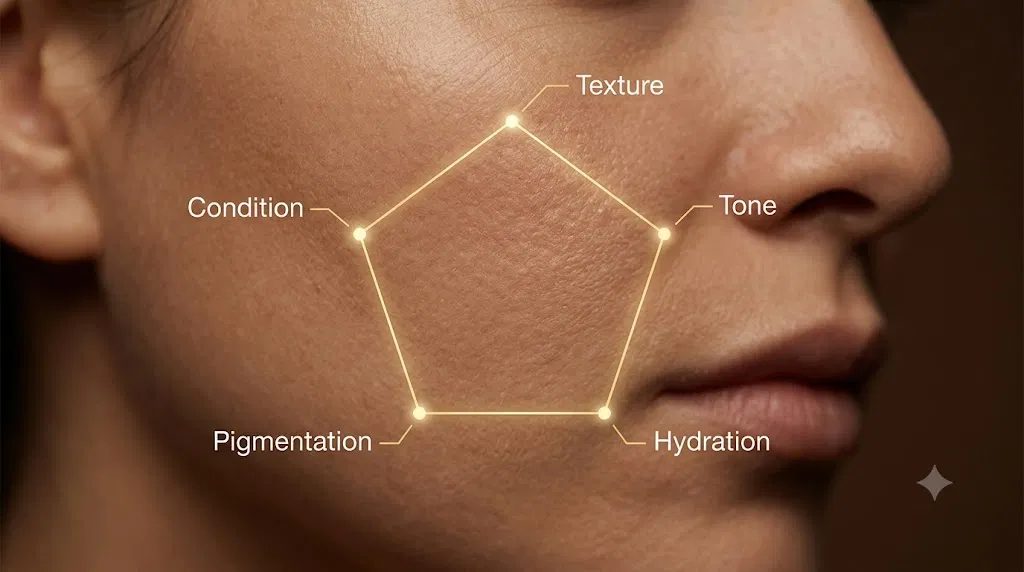
The five markers, explained properly
Texture This is about surface smoothness versus micro-unevenness, the kind of detail you can't reliably judge by touch or in a mirror under normal lighting.
Tone Not your overall skin colour, but how pigmentation is distributed across your face. Evenness matters here more than shade.
Hydration Actual water content at the surface, not the "tight" feeling that's often mistaken for hydration (and is sometimes the opposite: over-cleansed, barrier-stressed skin can feel tight while also being dehydrated).
Pigmentation Visible discolouration and unevenness in depth, separate from tone. This is what shows up as patches, marks, or uneven patches over time.
Condition A general read on skin health signals, barrier state, and visible stress. This is the marker that tends to shift fastest, since it responds to sleep, weather, and stress in the short term.
Alongside the per-marker readout, every scan generates a Skin Balance Score out of 100, so you can see your overall skin position in a single number as well as marker by marker.
Why five markers, and not just "oily or dry"
Because "oily or dry" isn't actually one variable, it's usually several of these markers interacting, and the same surface appearance (shine, for example) can come from opposite underlying causes. Treating the surface symptom without knowing the underlying marker is how you end up with a routine that fights your skin instead of supporting it.
What this means for your protocol
The Balanx System™ reads all five markers on every scan, and builds your protocol from the combination, not from a single symptom. That's why two people who'd describe their skin the same way in a quiz can get completely different routines from an actual scan, because their five-marker readings are different, even if their self-description isn't.
We're not diagnosing anything here. We're reading what's measurable, and building from that instead of a guess.